international · relaxation · travel

Summer Travel Plans … Or Not

Now that summer is officially here, I can start executing my travel plans!

.

.

.

.

And … I don’t really have any big plans. I’ll be in DC a bit more than usual, due to some conferences and a few in-person activities I have to do for work. Other than one weekend in Atlanta, I’ll be pretty close to home. I remember at one point in my life I would have been saddened by my lack of travel plans, but now I’m just enjoying the downtime. I did quite a bit of summer travel over the past couple of years which was fun but a tad tiring.

With my new role as a co-caregiver for my grandmother and great aunt, I’m no longer able to pick up and go whenever I want. I have to coordinate supervision and do resource management if I plan to take any trips. It may sound like a drag, but there’s a sweetness that permeates this situation. Aside from the satisfaction of knowing that my loved ones are well cared for, and that they are thriving in unprecedented ways, there is a loveliness that comes from being still and a tad domestic. Being home more means I can actually take a closer look at my surroundings and note, with precision, what I love and what doesn’t delight me. I figured out that this summer is a great opportunity for me to really finish turning my home into my dream house. I started already, by going through each room and ruthlessly analyzing what should stay and what should go. Once I’ve moved out what isn’t serving me, I can focus on only adding what thrills me.

Whenever I travel overseas, I often find myself having an incredible time, then coming home and having quite a bit of difficulty adjusting to my routine. It’s such a challenge getting back to the regularity of my life, and it’s in that regularity that I am my most accomplished, efficient and healthiest. So, by postponing my international travel until later this year, I give myself a chance to shore up my energy and get some of my ongoing home projects done before I get back to jet-setting. Not to mention, saving travel money this summer means more resources for incredible travel in the future!

Another perk of staying close to home during this time of the year is that it helps me to avoid many of the crowds that overtake popular vacation spots during the summer. I love London, Lisbon and Athens, but the number of visitors that descend upon those cities in the summer makes them less appealing. Navigating through throngs of people may not be completely avoidable throughout the year but it’s practically impossible during the summertime, especially in Europe. I’d rather go during a different time of the year, when most people are unable or unwilling to travel.

So, in short, no big summer travel plans. But I’m looking forward to the short getaways I have scheduled, converting my house into my dream space, and spending time with my friends. I can’t wait to take you all on this journey with me!

health

Fibro Friday – 5 Red Flags Your Doctor Might Miss

Happy Fibro Friday! I hope you all are doing well and are taking excellent care of yourselves.

I recently started looking back at my health history (thanks to my insurance for the decades-long record). I sometimes will look to see if anything is outdated, or if a diagnosis was slipped in unbeknownst to me. This most recent review didn’t turn up any unknown or outdated information, but I began thinking about my medical experiences and I asked myself, “Is there anything here that could have pointed to me being prone to developing fibromyalgia?” What I found surprised me: I had been diagnosed with multiple conditions over the years, all of which has shown some connection (some weak, some significant) to fibromyalgia. So, for this post, I’m going to tell you what conditions are fibro flags that you or your doctor may have missed on your road to diagnosis and treatment.

Before going further into this discussion, you may want to check out this journal article, titled, “The Prevalence of Fibromyalgia in Other Chronic Pain Conditions“. The researcher, Muhammad Yunus, outlines many of the conditions which have some determined link to fibromyalgia, and Yunus admits that the associations are bidirectional and the interrelationships haven’t been explored fully yet. I highly recommend that you take your time and go through this article as you try to determine if there is any overlap between fibromyalgia and any other conditions you may have.

Flag # 1: History of asthma – A 2020 study of Iraqi fibromyalgia patients confirmed that, “Fibromyalgia (FM) was more common in asthmatic patients compared with controls.” Perhaps it’s the fact that breathing difficulties would (naturally) trigger stress responses in the body, and those repeated stress responses condition the brain to interpret most stimuli to be more urgent than it actually is. Maybe being asthmatic trains the brain to be hyper-sensitive to everything. More study is needed to determine what this means for fibro patients, but it’s certainly something to keep in mind when coming up with a body of “clues” leading to a fibromyalgia diagnosis.

Flag # 2: TMJ syndrome – For several years now, it has been established that TMJ and fibromyalgia are linked, though the nature of the connection is still a bit unclear (a chicken vs. egg argument would fit in this scenario). This article by VeryWell Health references some excellent research on the topic. To put it plainly, it seems that TMJ actually may lay the groundwork for the sensitivity experienced in people that have chronic pain issues. As author Adrienne Dellwo states, “When TMJ occurs before CFS or FMS, it’s possible that TMJ pain contributes to the development of central sensitization. Hypersensitivity of the central nervous system is believed to be a key component of both fibromyalgia and chronic fatigue (also known as myalgic encephalomyelitis).” Again, this area still needs additional research, but there’s no doubting that a connection exists between the two.

Flag # 3: Epstein Barr Virus (Mono) or Lyme disease – Like the two previous red flags, we have to keep in mind that correlation =/= causation. That being said, there is research starting as early as 1987, which indicates that 55% of the test subjects self identified that a viral infection was the cause of their fibromyalgia. Personally, I was infected with mononucleosis in my 20s, and my fibromyalgia symptoms began and sustained after that point, often appearing as a chronic case of influenza or reactivated mono. More recent research confirms that EBV can either cause or contribute to fibromyalgia symptoms, which makes sense, considering that many of EBV’s symptoms overlap significantly with what many fibromyalgia patients experience (fatigue, body aches, even sore throat!) One article states that EBV “highjacks” the immune system, which may explain why fibromyalgia patients that have been infected with EBV tend to experience more sensitivity to viral infections like colds or the flu, as well as sustained symptoms once infected (I personally got a second positive result for the flu nearly a month after initially getting a positive result!) While I haven’t experienced Lyme disease, there is research from as early as 1992 which states that the bacteria responsible for this condition may be a potential cause of fibromyalgia. If you have either of these conditions in your medical history, please know that these may be contributing to your fibromyalgia symptoms.

Flag # 4 – Anxiety or depression – Anxiety and depression are chronic illnesses on their own, and, unsurprisingly, these are almost always present in fibromyalgia patients, too. This article on News Medical is informative and clearly explains the connections between anxiety, depression and fibro. The article, written by Dr. Anaya Mandal, MD, discussed the concurrence of these conditions, and how these overlaps contribute to exacerbated symptoms. According to Dr. Mandal, anxiety, “may increase the severity of pain perception and thus increase the severity of the disease.” Further, when discussing depression, Dr. Mandal writes, “Several studies have speculated that there may be a common pathophysiology between depression and fibromyalgia.” This should be a surprise to no one that has been diagnosed with anxiety or depression: in fact, one favored fibromyalgia treatment – serotonin and norepinephrine reuptake inhibitors, or SNRIs – are classified as antidepressants, and have had fantastic results when used to treat fibro.

Flag # 5 – Childhood traumatic experiences (CTE) – There is still a lot of research needed when it comes to this, but most of the research seems to agree that experiencing trauma in childhood can be a risk factor for fibromyalgia later in life. In fact, there is research that indicates that even the attachment style that we experienced from our primary caregivers may have a lot to do with our neurological health in later years. Interestingly, I have a loving, involved mother and a loving but inconsistent father, who divorced when I was 3 years old. My mother later remarried, and my stepfather was also loving, involved and consistent. So while my home life was stable, the inconsistencies that happened with my father had already made an impact. Further, a serious illness (such as asthma that required multiple hospitalizations in my childhood) is a type of trauma that can also create unhealthy attachment styles, which are a risk factor for fibromyalgia. I’m blessed to have grown up without physical, sexual or emotional abuse, and I’m also fortunate to not have been exposed to drugs or other substance abuse while in utero, but if you’ve had these experiences, your risk of developing fibromyalgia are even higher.

This post was a bit longer and “heavier” than my usual Fibro Friday content, but I wanted to cover something substantial, because I know what it’s like to try to “reverse engineer” your diagnosis and still be left with questions. If any of these red flags apply to you, please take heart. And if you’d like to discuss more about your journey and experiences with fibromyalgia, I’d love to hear about it in the comments.

Take care, and have a great weekend!
beauty · hollywood glamour · style

Perfume Review – Eilish No. 2

One of my favorite ways to embrace and engage my senses is to wear perfume pretty much every day. I’m always curious about trying new scents: I’m fascinated with how various notes interact with one another, and then how they combine with my own chemistry to create a personal scent signature. A recent trip to Ulta introduced me to Eilish No. 2: a warm, earthy fragrance that’s unlike anything else I’ve ever tried.

Eilish No. 2 is the second in Billie Eilish’s collection of scents, and this one did not disappoint. I smelled the first perfume she released (Eilish Eau de Parfum) and, while I enjoyed it, I didn’t feel confident that the scent would give me the wear time and sillage I desired. I like my fragrances to last a long time but also to project a bit, so I can be enveloped in my preferred scent. Though the first Eilish scent didn’t seem like it would fit my criteria, Eilish No. 2 impressed me right away. I love how this scent has depth but isn’t the typical spicy amber or gourmand: it’s warm and woody, a striking balance between earthiness and sweetness that I’ve rarely experienced. The notes for this scent are as follows:

Top: Bergamot, Apple blossom

Mid: Black pepper, Papyrus, Poppy

Base: Palo santo, Ebony, Vanilla

One look at these scents and you can see what I mean: dry spiciness (courtesy of the black pepper) crisp, fresh slightly tart top notes, and the warm woody base that is sweetened just a bit with a vanilla that is neither syrupy nor sickly. I wore this scent and it lasted all day, and the sillage was fantastic. I loved it! Here’s my video reviewing Eilish No. 2:

This is one of my favorites! I got the 1.0 fl oz (30 mL) size for $52 USD. It’s a bit heavier than I usually wear during the summer months, so I’ll be putting this one away until the cool weather returns. If you’re looking for something different, this one may be worth checking out!

health · life curation · relaxation · Uncategorized

Fibro Friday – How I Deal With Chronic Headaches

Happy Fibro Friday! The weather is getting warmer each day, and I find myself feeling happier and more energetic. The summer season is HERE!

June is Migraine and Headache Awareness Month. As someone that has dealt with chronic headaches for almost 20 years, I know a little something about a “mal à la tête” (one of the few phrases I managed to retain decades after taking my last French class). However, I was not aware there was a month dedicated to all of us that have to deal with headaches and migraines on a regular basis. I’m fortunate to have never experienced a migraine (though my mother used to have them when I was younger), but I often have tension headaches and other pain patterns.

The weird thing that I’ve noticed about having that chronic headaches is the fact that I almost always have a low level of pain going on. It’s very similar to how fibromyalgia works: pain is a fairly constant companion, but the level of pain is what makes the difference. My headache may be (on a scale of 0 to 10, with 0 being no pain at all and 10 being severe enough to warrant an emergency room visit) either a 2 or an 8, but never 0. The pain is minimal on some days, but never completely gone. I’ve gotten really adept at functioning without pain medication on any day that’s less than a 5. That may sound awful, but when something has become your normal, you almost don’t recognize it. And, in the case of days where my pain level is a 1 or 2, I often feel ecstatic and like I can conquer the world!
A big part of how I manage chronic headaches is that I have an arsenal of things I do BEFORE I choose to use a pain medication. After years of using over-the-counter medication in an attempt to manage neurological and musculoskeletal pain, I became concerned with the long-term effects of these substances. Therefore, I try to avoid them for as long as I can comfortably manage. When I feel a slightly stronger headache, I don’t immediately reach for ibuprofen or acetaminophen anymore. Here’s what I try before I reach for pain

  • Check my hydration levels: I drink some water, because 9 chances out of 10, I’m dehydrated. Starting my day with a large glass of water is a great move that works well when I remember it. I usually keep a large glass of water on my nightstand, so I can sip before I go to bed and finish it in the morning.
  • Use my weighted eye mask: I’ve reviewed my eye mask over here before, and I still love it. There’s something about the counter pressure that really gives me relief. It’s a pretty inexpensive investment (I got mine from Amazon), and I find that laying down for a few minutes with this mask can really help with the pain.
  • Do some jaw and neck stretches: since most of my headaches are tension related, gentle stretching can relieve some of the tightness that contributes to the pain. This may not be particularly helpful if you suffer with migraines, or if your headaches are not tension related. But if you find that you clench your jaw or otherwise hold your face or neck muscles tightly, stretching them gently may help to loosen up those muscles and take off some of the pressure.
  • Pay attention to my triggers and actively avoid them: sometimes seasonal allergies, certain foods, or even particular daily routines can be headache triggers. If I recognize a trigger, I avoid it as much as I can. That can mean avoiding trips outside of the house during the peak pollen or poor air quality days, refraining from bread and other starchy foods, or getting extra sleep so that I don’t have an exhaustion-induced headache.
  • Eat something, and make sure it’s the right food for me: sometimes, the pain comes from eating too late in the day, not eating enough throughout the day, or eating the wrong food. A huge helping of fresh fruits and vegetables tends to give me a little relief. I’m sure it’s because these foods are more easily metabolized by me, but also, fresh fruits and vegetables tend to be very hydrating.

I discuss my practices for dealing with chronic headaches in one of my recent Fibro Friday videos. You can see it below:

Do you have chronic headaches? What have you found that works in helping you to manage them?

beauty · relaxation

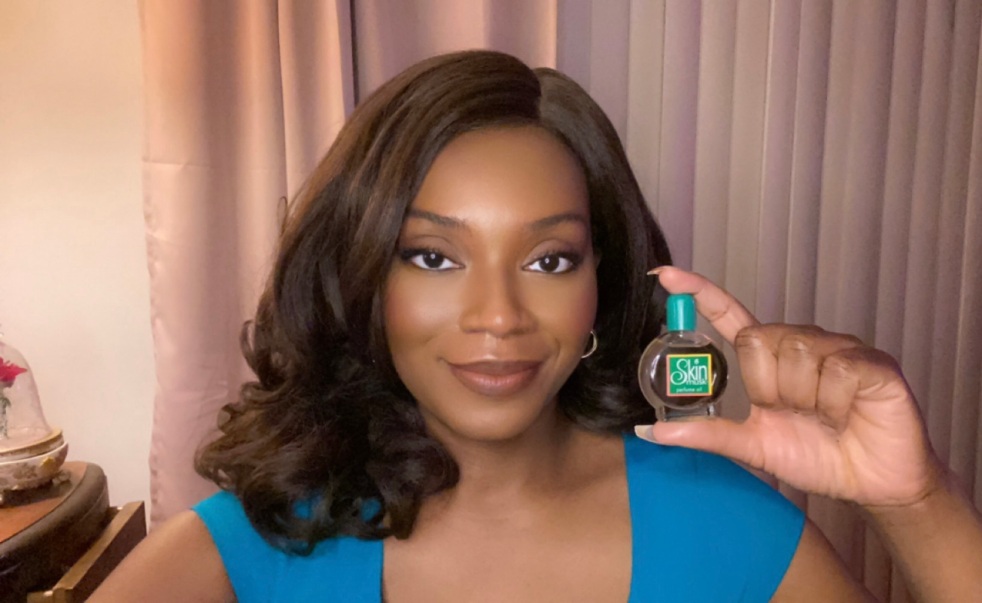
Perfume Review: Skin Musk Parfum de Coeur

Fresh, clean, easy to wear: of course it was only a matter of time before I bought and reviewed Skin Musk by Parfum de Coeur. As someone that LOVES musk fragrances (like Musk Rose by Al Rehab and Diptyque Fleur De Peau [review coming soon!]), I was compelled to buy this classic perfume. I remember seeing this scent in drugstores and Kmart when I was young, and, as it turns out, it had been around for a long time before I was born (it launched in 1975). Nearly 50 years into its existence, it finally made its way into my review rotation!
I expected this oil to have a straightforward history, but as it turns out, the fragrance’s backstory is a bit muddled. Skin Musk was originally released by Bonne Bell, and at some point the scent was made by Prince Matchabelli (the company that I remember from my youth). At this point, I’m not clear on whether Prince Matchabelli still makes this scent, or if the company that currently makes Skin Musk – Parfums de Coeur – is the sole producer. Aside from the manufacturing history, the formulation itself has changed, and there are plenty of dissatisfied users that have commented on the thicker consistency and slightly more complex notes present in the original version. While there are plenty of discussions online that debate the current iteration of the scent and how true it is to the original version, I decided to just stick with and review the recent version.

I ordered the fragrance on Amazon, and I eagerly tried it when I got my bottle. I took off the cap and I was immediately hit by the familiarity of the scent: I couldn’t place it at first, but then it occurred to me. This scent was quite popular when I was younger (definitely ubiquitous) and I’m sure I was often in the presence of people wearing it. More impressive, however, was how much this scent reminded me of my mother. That’s when it occurred to me: Skin Musk was just like Egyptian Musk (the popular oil available at many incense seller stands and beauty supply stores) but without the light spiciness.

I wore this all day and it lasted beautifully. It wasn’t overwhelming: it remained soft and powdery, but with just a touch of base to it (the sandalwood in this formula is elegant and not too woody). The sillage is lovely, and this is the perfect scent to wear when you want something tasteful, pretty and not too aggressive. It’s a perfectly polite fragrance. I love it!

Here’s my review of Skin Musk on YouTube:

Have you tried this lovely fragrance before? I’d love to hear your thoughts on it!

(This post has affiliate links.)

beauty · luxury · style

Perfume Review – Rare Vanilla Blossom by Jones New York Signature

Perfumes have really been a mood lifter for me recently, and I’m so happy that I’ve had this very long streak of delightful scent purchases. I’m always interested in fragrances that can tell a story, and this lovely one is no different.

I got Rare Vanilla Blossom by Jones New York from Marshall’s last year, and what a buy this was! The bottle is substantial – 3.4 fluid ounces, or 100 mL- and it only cost $12.99 USD, Because this came from a discount store, I cannot guarantee you’ll be able to find it for the same price, but it is available at Walmart.com, so if you’re interested, you can pick it up from there.

I’ll share the notes, how long I could smell it on my skin, and overall first impressions. Here are the notes as listed by Walmart:

  • Mandarin & lemon blossom
  • Jungle lily & Vanilla bouquet
  • Musk & Brown Sugar

I was excited to see that musk and vanilla are some of the notes in here, but my excitement turned to something much . . . milder. While I could pick up on the musk and vanilla, the brown sugar was the most prominent note to my nose. If you don’t like gourmands, avoid this one: there isn’t enough lily or musk to balance against the sweetness of the vanilla and brown sugar. However, if you love gourmands, this may be a scent worth checking out!

I found that I had to reapply this a couple of times. I understand going “nose blind”, but this was not the case, and I wasn’t surprised: I generally don’t get fantastic wear time from any vanilla perfume unless I layer generously with complementary products. So, I tried wearing it alone, and I also tried layering it, and it still didn’t last very long. I was a bit discouraged that I didn’t get significant wear time, but I am realistic about value for dollars, and for the price, I’m not surprised it didn’t last as long as I prefer. Fortunately, this bottle has a lot of product, so you can spray a lot and it will take a while before you exhaust your supply.

I loved that this came is a lovely, heavy glass bottle and it looks elegant on my vanity. It has very luxurious packaging: my weakness! It smelled cozy, like warm baked goods, and does a great dance between timid and syrupy sweet. Because it’s so gourmand forward, I would wear it more during the cooler months than in the summer. However, vanilla and brown sugar are fairly versatile notes, so if you really enjoy this scent profile, it can easily be worn during the warmer months, too. I enjoyed it, though I wouldn’t purchase again (it just didn’t suit my personal scent preferences). I’d also gift this to some of my family or friends that enjoy smelling like caramel candies.

If you want to see my video review on this, here you go:

That’s it for Jones New York’s Rare Vanilla Blossom? Do you have it? What do you think of it? I’d love to hear your comments!

health · words of wisdom

Fibro Friday – Boundaries As A Form of Flare Management

We’ve arrived at the end of another week, and I’m delighted that I get to share with you all some more of my fibromyalgia insights. I have to say, this condition has taught me an infinite number of lessons (truly, more than I could ever recall for the sake of blogging). And even when I think I’ve got a good handle on a particular lesson, life always gives me the opportunity to attain a new level of depth and comprehension.

This past week, I got to revisit a lesson on boundaries. When managing chronic illness, boundaries are especially important, both to prevent overwhelm and to manage overwhelm when it occurs. If you haven’t practiced saying enthusiastic yeses and firm, confident nos, you may find that this isn’t an easy thing to do. But mastering this skill is vital, because one of the biggest pain culprits is overextending ourselves and being under a ton of stress. Effective boundaries can reduce or eliminate stress and make it easier to avoid or manage flares.

I did a video all about this topic: you can find it below:

If you’re unclear about what boundaries are, and how to deploy them effectively, the book Boundaries: When to Say Yes, How to Say No to Take Control of Your Life by Dr. Henry Cloud is a great place to start. This book drastically changed how I viewed yes and no in the context of all relationships, including the relationship I have with myself. I highly recommend it!

That’s it for Fibro Friday. Please continue to take care of yourselves, and I’ll talk to you all soon!

*This post contains affiliate links.

books · life curation · reading list

My Reading List, April 2024

I just finished a few books recently, and now I’m on to the next set of books to read!

I hope that this new month has been treating you all well. I had a difficult time with my health recently (more about that on Friday) and I decided to lean into more enjoyable, restorative activities to help with that. One of my favorite activities for restoring my energy is reading. Recently, I completed a few books: first, I reread, Write It Down, Make It Happen by Dr. Henriette Anne Klauser. I’m considering doing another review on this, since I had some new revelations while reading it. Secondly, I reread How To Think Like Leonardo da Vinci by Michael J. Gelb (it seems that March was a good month to reread some of my favorites!). This one I’ll definitely do another review on, since I honestly felt like I was reading it for the first time: it’s been so long since I read this one, and I got so many great takeaways this time! And, as you all know, I finished True Gifts by Jewel Veitch last month, too (I reviewed it here).

Over on my YouTube, I listed the books I’m reading in April. This week, I’ll be finishing up Where The Forest Meets The Stars by Glendy Vanderah. I’ll also be diving into Take Care of Your Type – An Enneagram Guide to Self Care by Christina S. Wilcox. I’m curious about how I can leverage the enneagram to improve my life, so this should be an interesting book to read. I’ll also be reading The 5 Love Languages of Teenagers: The Secret to Loving Teens Effectively by Gary Chapman. As the parent of a pre-teen, I’m always looking for ways to deepen and strengthen our communication and connection, and I am a fan of Chapman’s work, so it’ll be great to see what strategies I can try with my child. Finally, I’ll be reading Pause, Rest, Be – Stillness Practices for Courage in Times of Change by Octavia F. Raheem. The author led a rest practice during ExodUS Summit 2023, and I was very impressed by the exercise. I’ll be replaying the rest practice at least once while I read the book.

Anyhoo, here is the video summarizing my reading list:

What are you reading this month? I’d love to hear what books you’re enjoying right now.

*

*

*

*

  • This post features affiliate links.
Uncategorized

Book Review – True Gifts by Jewel Veitch

The book I’m reviewing is one of my favorites of the year (so far) True Gifts by Jewel Veitch is a fascinating self improvement book that promises to help you uncover your talents and give you the first steps to creating a fully actualized life. The author does this by asking deep questions and providing exploratory exercises that go beyond the fluff that is typically included in self help books. If the questions and exercises are completed in the way that Veitch encourages, the reader will absolutely uncover new data points and be well on the way to crafting a dream lifestyle.

True Gifts is a partially biographical workbook of sorts: it tells of Veitch’s path to stepping into boldly living her life, including some of the devastating events that put her on her path. The book also tells the stories of some of her clients, some of whom most people will be able to relate to in some way. I really enjoyed one of the clients she mentoined, who was a retired teacher that came to her, “empty, tired and directionless”. It was through her work with Veitch that she uncovered her playful, creative nature again, which revived her love for teaching. Instead of letting her love for instruction usher her into recreating the same energy-depleting career she’d just left, she was able to find a school where she could bring her most delightful self back into a classroom setting where her gifts could fully shine.

The questions that Veitch includes in her book really get to the heart of your unique gifts and desires. One of the questions that is posed in Chapter 4 really made me stop and examine my dreams a little closer was, “How do I embrace [my dream] fully, or reject it in ways I’m not even aware of?” Reading this queston was like a gut check: the truth is, if you’re not living your dream, then it’s clear that rejection of some sort is happening, even in small, inconspicuous ways. The following question, “How do I communicate with [my dream] to hold it close?” further highlighted how knowing the dream wasn’t enough: being in communication (specifically, meaningful, regular connection) with it is required.

The book is about 3 hours worth of reading time (a perfect length if you’re someone that prefers to get through books quickly) but if you want to get the most out of it, you’ll have to use some additional time to explore the questions and activities that Veitch outlines. This book is not for passive consumption: this is absolutely a WORKbook, (emphasis on WORK), and the inner work that this book walks you through is potentially life-changing and certainly life-affirming. If you’re unsure about who you really are or why you’re here, this book would be a great one to explore. I can confidently recommend this book as a companion on your self mastery journey.

True Gifts is one of many excellent works published by Difference Press. Headed by Dr. Angela Lauria, Difference Press specializes in publishing the works of transformational coaches, speakers, and leaders. I have enjoyed several of the books released by them, and I continue to be impressed by the quality of the work presented by the authors that are coached and developed through Difference Press. If you aren’t familiar with them, please check out their website and get onto their mailing list. And, if anything about True Gifts inspired you or piqued your curiosity, then please check out Jewel Veitch’s website and join her mailing list as well.

That’s it for today, friends. Please take care and I’ll talk to you all soon!

*This post has referral links.

life curation · luxury · travel

Is This The Best Hotel In Edinburgh?

Last summer, I did a short visit to Edinburgh, Scotland. I regret that I didn’t have more time to enjoy this exquisite city, but I take the brevity of my trip as a fantastic reason to return at some point in the near future.

I stayed at the Kimpton Charlotte Square, a luxury hotel located near the Royal Botanic Garden and the National Galleries of Scotland. Because the hotel is located in the city center, it’s very easy to get to a lot of different attractions, and it’s impossible to get bored in this incredible city.

I was greeted by a warm and friendly staff: certainly the warmest and friendliest of any that I encountered in the UK. I was given a tour of the hotel, as well as an overview of the amenities included with my stay. I settled into my room then explored the grounds. The interior design of this hotel is stunning: it’s both traditional and eclectic at once. It seems like the dazzling displays would compete with one another, but the decorations are cohesive and aesthetically pleasing. Somehow, it all just goes together.

Many times, after a long trip, I find myself hungry, but not yet ready for a full meal. Imagine my surprise when I saw that my room was stocked with complimentary snacks, as well as a massive list of all the items that the hotel could either give or loan to you in case you need them (think phone chargers, humidifiers, rubber bathmats, yoga mats, etc.,). It was an absolutely perfect touch that I expect from a luxury hotel but, alas, many miss the mark on this.

My stay included the breakfast buffet, which was not only convenient but delicious. There was also the cocktail hour (available to all guests) which was lively and social. Upon looking at the Kimpton Charlotte Square website, I see that visitors can opt for half board (breakfast and dinner) at the hotel, which is exactly what I’ll do when I return.

I’m not sure if my affection for Edinburgh was founded strictly on my Kimpton Charlotte Square experience, but I can certainly vouch for the fact that any trip to this magical city would be made better by a stay at this hotel. As a little tip I learned through my research, the peak (read: priciest) times to travel are the summer months and the Christmas/New Year period. Any other time of the year will give you the same lovely experience but for a lower cost.

While you’re at the Kimpton Charlotte Square, be sure to walk a few blocks to the Scotch Malt Whisky Society. This whisky lounge is charming and gives you a great excuse to come out and learn more about uisge-beatha (the Scottish Gaelic word for whisky, that literally translates to, ‘water of life’).

Have you been to Edinburgh? If not, is Scotland on your travel list? I’d love to know more in the comments below. I’ll talk to you all soon!