art · life curation

The Next Art Course On My List

I had such a positive experience with my previous ALISON course (Great Artists and Their Works) that I decided to try another. In the next couple of weeks, I’ll be diving into Color Theory for Artists and Designers on ALISON.com. I’m neither an artist nor a designer, but increasing my knowledge on the subject would be extremely advantageous.

Untitled design (2)

I reviewed the modules that comprise this lesson and I was impressed with the variety of color-related topics that will be discussed. This seems like a really good, brief “in-between” class to take while I figure out the rest of my educational plans as respects my future art-related career (I wrote about my short-term art career goals here).  Besides, I like makeup too much not to get a better grasp on certain color concepts.

Yeah, today is a brief post. I’m working on the edits for the novel, as well as the art career stuff, so I’m keeping this short so I can pour my energy into those other things on my to-do list. That’s it for today – chat with you all tomorrow!

art

Smithsonian Highlights – April

Hey friends! As you all know, it’s hard for me to stay out of the Smithsonian’s museums, because 1) I work right by several of them and 2) I’m addicted to art exhibits. I figured I would create a list of some of the Smithsonian’s highlights for the month of April. If you’re planning a trip to DC, or you are already in the area, here’s some of the must see/must do activities hosted by the Smithsonian Institute. 

Untitled design - Edited (2)

DIANE ARBUS: A BOX OF TEN PHOTOGRAPHS exhibit opens on April 6 at Smithsonian American Art Museum (SAAM). Arbus is credited as being the artist that elevated photography into a “serious” art discipline. Her photos bridged reality and artistry, and SAAM has a exhibit for us to enjoy for the remainder of 2018.

Marlene Dietrich: Dressed for the Image : I talked about this exhibit in this post. It will be leaving National Portrait Gallery (NPG) on April 15, 2018. You won’t want to miss this stunning and stirring photos of Dietrich. For those that don’t know, NPG is housed in the same building as SAAM, so from April 6 to April 15, you can check out A Box of Ten Photographs then swing by Dressed for the Image without missing a beat.

GALLERY EXPERIENCE: SLOW ART DAY April 14, 2018, 10:30 AM5:00 PM at the Hirshhorn Museum (and at pretty much every museum nationwide) If you can, stop by any art museum on April 14th to participate in Slow Art Day where, instead of rushing through the exhibits trying to absorb a little of everything, you can take your time and enjoy the art for the perspective-broadening experience that it is.

If this quick summary of the Smithsonian’s juiciest exhibits has been helpful, then I’ll be sure to make it a regular feature. Hope you enjoy!
art · luxury

Why Private Tastes Run Public Art Museums

As an art enthusiast, I enjoy following the trends and learning more about the industry. Nowhere have I seen such a collision of creativity and business as I have in the art world. What I find especially fascinating is how art professionals make their mark or how they navigate these spaces during their careers.

brooklynmuseum-o4836i000-74.208_SL1

The Carpet Merchant of Cairo by Jean-Leon Gerome

I recently read an article by Felix Salmon explaining the unexpected termination of Museum of Contemporary Art Los Angeles (MOCA LA) curator Helen Molesworth. The article indicates that the firing was “controversial”, so the opinions about the termination are varied. However, the underlying reason why Molesworth was released may be discerned from data related to her time at MOCA LA.

Data analytics were used to determine the difference between curatorial choices made by Molesworth and selections made by previous curators. The data confirmed that, prior to Molesworth’s tenure, the museum’s special exhibits prominently featured art “market darlings”: the artists that patrons regularly purchased for their personal collections and that had sold well at auctions. Artists that commanded high dollar prices at auction ($10+ million gross) were frequently featured in MOCA LA exhibits. However, during the three years that Molesworth was at MOCA LA, only two of her curated exhibits exceeded the $10 million gross amount.

brooklynmuseum-o1441i000-69.43_SL1

The Moorish Warrior by William Merritt Chase

This is a simple matter of economics: patrons know that the value of their investments needs to be affirmed by museums. Museums and patrons have a symbiotic relationship: they mutually affirm the value of certain artists’ works. It’s important that art “market darlings” are heavily featured so that art investors can justify the valuation of their investment.

Here lies the problem with Molesworth: she didn’t feature art “market darlings” prominently during her tenure. Her emphasis on display diverse artists that weren’t pulling in high dollar amounts at aucton didn’t win her any fans with the old art vanguard, namely, the trustees of MOCA LA. In many ways, her innovation and commitment to smaller, lesser known, less commercially popular artists sealed her fate.

brooklynmuseum-o4507i000-00.159.131_PS2

The Daughter of Herodias Dancing by James Tissot

An additional point of clarity: MOCA LA has minimal government funding. Donors are quoted as providing 80% of the museum’s funding. This means that it behooves the museum to consider the personal tastes of their financial supporters. Molesworth’s choices didn’t endear her to donors, because her curatorial choices didn’t reflect the work of the “market darlings”. Her curated exhibits didn’t affirm the value of donors’ collections; she was inadvertently setting the tone for a shift away from the “darlings” and a move toward more lesser known artists. A death knell like this could have been catastrophic for the valuation of donors’ private art collections.

brooklynmuseum-o1465i000-71.200.5

Study of a Moor in Blue by Edwin Lord Weeks

All his being said, I actually am in favor of MOCA LA’s decision. Museums that receive the majority of their funds from private donors are beholden, to extent, to the tastes of those donors. As a museum attempts to steer its collection and exhibits to align with the vision of the supporters, it makes sense to have curators that are also on board with that vision. I’m unsure whether MOCA LA expressed to Ms. Molesworth what they wanted from her in her role as curator, but I can hope that this was explained at some point. If not, some research on previous exhibits would have been wise: a cursory review would have revealed an affinity for certain artists. Molesworth could have gradually introduced artists with lower gross auction amounts while still curating exhibits that would be favored by the donors.

brooklynmuseum-o64i000-15.300_SL1

The Old Blue-Tiled Mosque Outside of Delhi, India by Edwin Lord Weeks

The practical application in this case is this: when entering a new space, always do your research. The discussions among colleagues are great but the numbers don’t lie. Gather data and look for trends. See what the similarities are and plan accordingly. I don’t know that Molesworth could have completely avoided this – after all, she had to stay true to her own vision as a curator – but her research may have revealed that she wasn’t as good a fit for MOCA LA as she originally believed.


(This post featured art that had a Middle-Eastern/Indian theme. All photos courtesy of the Brooklyn Museum, as shown on archive.org)

art · luxury

Art Collectors Conundrum: Unpredictability

In the Art Collectors Conundrum series, we continue to explore some of the topics of interest for inexperienced art collectors/appreciators or aspiring art world professionals. Instead of simply noting the issue at hand, we ponder some ways to mitigate some of the invisible barriers of the art world.

Screenshot 2018-03-26 at 10.44.46 PM - Edited

(all photos by James Van Der Zee)

One of the biggest stumbling blocks on the road to art connoisseurship is unpredictability within the art market. Many would-be collectors are unnerved at the thought of investing significant amounts of money into art, only for that art to potentially never appreciate in value.

Screenshot 2018-03-26 at 10.44.58 PM - Edited

Here’s the problem with that logic: it assumes that art is purely an investment, when, in fact, art, is a tangible item that can be enjoyed now while also possibly growing in monetary value in the future. Let’s face it: we choose to invest in different things all of the time. We invest in our homes, our cars, our personal appearance, our careers, and our families. Many of these things are depreciable assets (cars will lose value, we won’t look 22 forever). However, art is one of the few investments that can be potentially monetized at a future date, though you can enjoy it right now, while you own it.

Screenshot 2018-03-26 at 10.44.53 PM - Edited (1)

The key to weathering the unpredictability of the art resale market? Only purchase art that you completely enjoy NOW. As a new collector, there’s no need to speculate about how much the art will be worth in the future if you’re enjoying the art right now, as it hangs on your wall or stands in your living space (in the case of sculptures).

Screenshot 2018-03-26 at 10.44.58 PM - Edited (1)

There’s no concern over how a piece will appreciate if you’re “appreciating” the piece right now, as it holds space in your collection. Focus on purchasing the art that moves you, the art that lights you up or makes you stop and think. Only buy the art that invokes feelings in you. Then, no matter what the art is worth today or tomorrow, you will have enjoyed it and you will have gotten immeasurable value from it right NOW.

(all photos courtesy of the Virginia Museum of Fine Arts digital exhibit, The Black Photographer’s Annual, Volume 1)


art · life curation

Edmonia Lewis’s Work at the Smithsonian’s American Art Museum

Happy Friday, friends! We made it through another week – hurrah!

Earlier this week – before the Mid-Atlantic region got hit with another round of snow – I stopped by the Smithsonian American Art Museum (SAAM). Visits to the museum are good for my soul, and, since most schools are still in session, I don’t have to navigate around a lot of tourists. I can usually get to the museum, tour to my heart’s content, and return to my desk in under an hour. Sometimes I really love working in DC!

logo

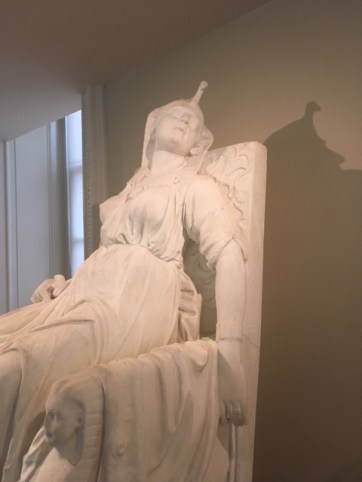
Anyways, I recently went to SAAM for a very specific reason. I had researched Edmonia Lewis’s existing artwork and confirmed that one of her most famous pieces, The Death of Cleopatra, was located at SAAM. After learning that it was currently on view, I knew that I had to go and see it for myself.

portrait_image_113711

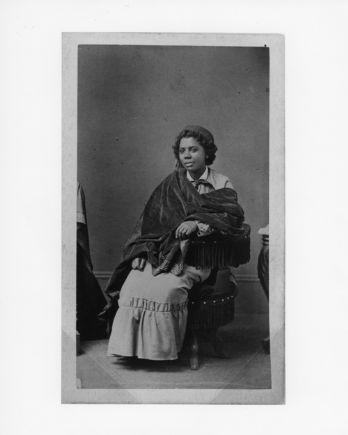
Photo of Edmonia Lewis (as shown on SAAM’s website)

I talked about Lewis when I wrote about my current favorite app. In that same post, I referenced an Art History Babes podcast episode that discussed Lewis’s life. I saw a few of her works on Google Arts & Culture but viewing art in person is so much more enjoyable. The surprise for me was that several of Lewis’s pieces were on view, so I took lots of pictures during this visit.

IMG_3571

Here is The Death of Cleopatra. This depicts Cleopatra seated on her throne, life slowly slipping away after being bitten by a poisonous snake. She’s dignified even in death, wearing her crown and full regal attire.


She’s substantial and powerful, and has chosen to die on the throne that she worked so hard to preserve. It’s a moving piece and a fine example of Lewis’s marble sculpting prowess.


A close up of the throne detailing and Cleopatra’s lifeless hand.

Lewis also sculpted Moses, a replica of the statue of Moses rendered by Michaelangelo (the original is at St. Peter’s in Rome). The original is much larger than Lewis’s version, but the resemblance is uncanny. Lewis skillfully imitated the works of great masters.


I wish I could have gotten some better photos, but it’s in a case so the reflection off the glass makes it hard to capture the detailing.

This whimsical statue is Poor Cupid, depicting the god of love caught in a trap. Cupid’s “aww shucks” expression made me chuckle.


As always, I enjoyed my trip to SAAM. There are a few other pieces by Edmonia Lewis on display: I may do a follow-up post about those works. In any case, I hope you enjoyed this post! This weekend, see if you can spend a little time at your local museum. You’ll be glad that you did. Until tomorrow . . .

art · international

More Kenyan Artists to Check Out

As an aspiring art professional, I always have an eye out for unique art wherever I go. I am a sucker for the classics, but I get a thrill out of finding contemporary artists that appeal to my personal tastes.

While in Kenya, I visited the Nairobi National Museum but I couldn’t take pictures in the photo gallery, as those pieces were for sale. However, I found myself “oohing” and “aahing” too much to just look at the paintings and walk away. So I jotted down the names of the artists and decided to look them up when I got home. I’m glad that I did, because now I can share these talented creators with you all!

12

A photo from The Next Gen Exhibition featuring Kenyan artists (photo from Artleeyo)

As it turns out, the many of the pieces featured in the Nairobi National Museum were done by local graffiti artists. The main three artists featured in the gallery – Kaymist4, Thufu B, and Msale – have formed a street art group named the Bomb Squad Crew. Their art is featured on the website BSQArt.com.

Work by Kaymist4

I had problems viewing the pages of the website, but I’m not sure if that is because the website has portion under construction or because I’m located outside of Kenya. In any case, you may have more success in navigating the website. I’m still researching the best way to purchase some of their pieces.

Work by Msale


Two more artists that were featured were Ssali Yusuf  (who is actually Ugandan, not Kenyan) and Remy Musindi.  Both artists skillfully use color, though Musindi’s color choices tend to be more subdued, while Yusuf’s are more saturated and crisp.

Piece by Remy Musindi

The trend I noticed in the artwork that I saw was vivid rendering of the female form. A focus on portraying the beautiful faces of African women is a common theme in Kenyan art. As an art lover that prefers portraiture over landscape and abstract paintings, I can appreciate the theme.

If you are interested in buying art online, I highly recommend that you use a reputable third party to handle the transaction, even if the purchase is relatively inexpensive. Galleries like ArtspaceSaatchi Art and UGallery specialize in connecting artists with collectors, and they can work out details like shipping and proper framing. You can find more more online galleries through this link.

art · life curation

Art Synchronicities


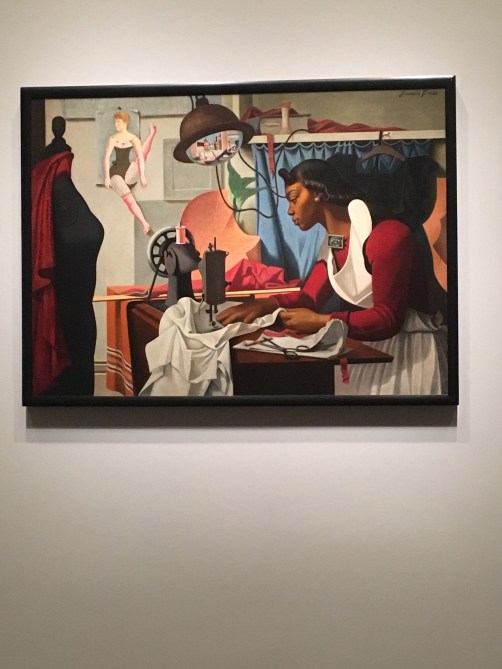
When I went to the National Portrait Gallery to view the Marlene Dietrich exhibit (you can read all about it here), I got a bit of a surprise. While walking around and trying to find Marlene, I came across a painting that stopped me in my tracks. You can see the painting below:

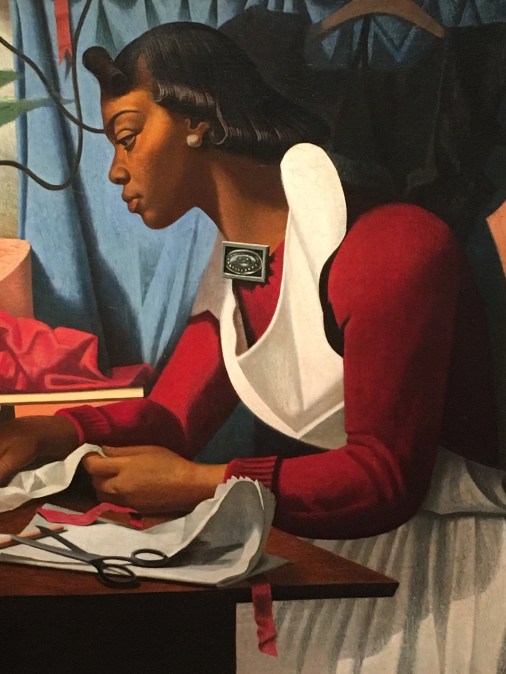
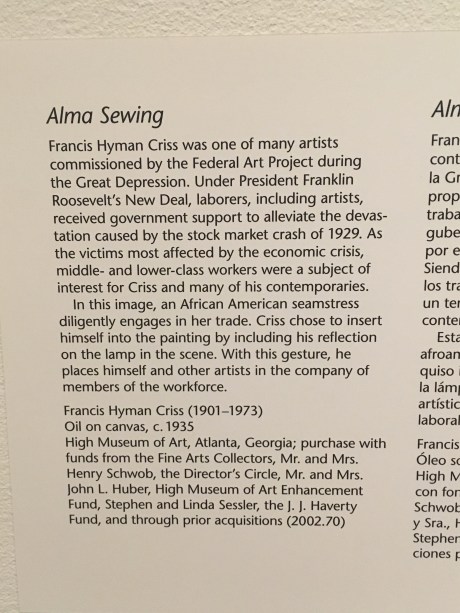
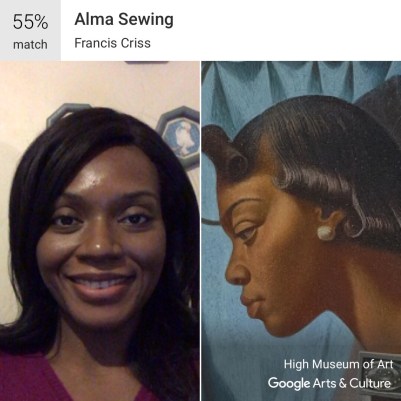
This painting is the very same one that was my most likely doppelganger, per the Google Arts & Culture app (you know, that app that I wrote about a while ago). Of course, on the app, the painting is listed as being at the High Museum of Art in Atlanta, GA. However, it is currently at the National Portrait Gallery, as part of The Sweat of Their Face: Portraying American Workers exhibit. I’m pretty sure that the painting will return to the High Museum in September, when the exhibit draws to a close.

I examined the painting and found myself smiling. The vivid colors can’t be captured via camera: it must be experienced in person. The focused gaze, the high cheekbones, and the richly hued skin did, oddly enough, remind me of myself. Of all of the paintings to make it to this exhibit, this one made the cut. And of all of the museums I could visit in DC (and there are PLENTY), I ended up at the National Portrait Gallery. And this painting had an entire wall to itself, so I couldn’t miss it as I walked to the Dietrich exhibit. I figure it was meant for me to see it. Oh yes, and here is the photo that convinced Google Arts & Culture that I am Alma’s incarnate:

I’m delighted that I got to see this painting: as always, art is best experienced in person. This is one of several portraits depicting the working class in the first half of the 20th century. I encourage you all to go and experience the exhibit for yourself, if you have the chance!

art · luxury

Art Collectors Conundrum: Culture Clash

As explained in previous posts, Art Collectors Conundrum explores the current issues surrounding art collecting. There are a lot of different issues that impact new collectors as they journey into the art world, and one of those big issues is the dissonance that exists between aesthetic indulgences and minimalist ideals.

Screenshot 2018-03-03 at 9.22.19 PM - Edited

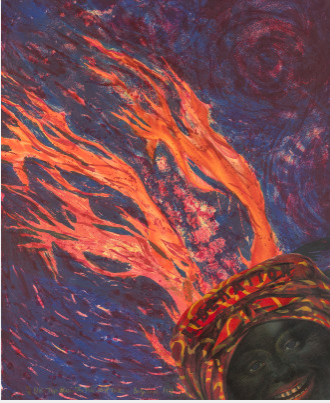
Betye Saar, Blow Top Blues, The Fire Next Time (1998)

The thing is, the culture of today’s wealthy – especially wealthy millenials – leans more toward minimalism and less toward acquisition of material goods. Any time spent on social media will confirm the “shift” from a culture of excess to one of spartan decorating practices. Many millenials favor the bare walls and monochrome decor that makes for clear, appealing Instagram photos. And, if they select art, the art often lacks the color, texture and excitement that used to be favored by collectors.

4049-132_WSS

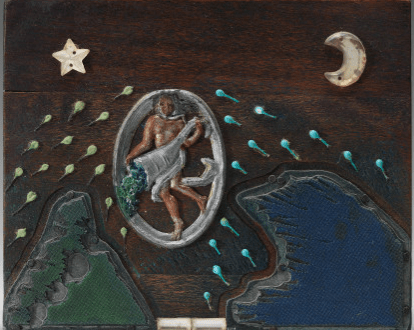
Betye Saar, Indigo Mercy (1975)

In short, this cultural clash results in fewer “new” big spenders. Bloomberg wrote about the “new elite” and their artistic tastes. The article points out that location has much to do with the cultural difference, too: East Coast “new money” tends to buy art in the more traditional fashion, while West Coast “new money” isn’t as interested in purchasing pricey art “for arts’ sake”.

Screenshot 2018-03-03 at 9.22.12 PM - Edited

Betye Saar, Twilight Awakening (1978)

The key to luring in these potential art investors isn’t as simple as one would think. The most important thing to remember about the new wealthy is that they are earning their fortunes much earlier than the wealthy of previous generations. They just aren’t as likely to be focused on art collecting if they are buying their first homes and starting families.

An interesting way to get the new wealthy interested in collecting could be an art loan program, which allows them to enjoy works for a fixed period of time and then they can purchase the work if they want, or turn it back over to the gallery to “try out” something different. It isn’t a perfect solution but it would provide them with some exposure to fine art and would help them hone in on their personal tastes and preferences.

Those are some of my thoughts on overcoming the dissonance between minimalist goals and owning art. What are your thoughts? Feel free to share your comments below!

(all art by Betye Saar and in the National Gallery of Arts collections)

art · international

International Art: Tom Mboya, Kenyan Artist

While vacationing in Kenya, I noticed that my hotel (Ibis Styles in Nairobi’s Westlands neighborhood) had beautiful artwork lining the stairwells. Upon closer inspection, I saw that all of the paintings – about 30 in total, displayed in sets of 3 amongst 10 different floors – were done by Tom Mboya.

My curiosity kicked into overdrive and I started researching Mboya. As it so happens, Tom Mboya is a local Kenyan artist (no surprise there) that started out working in the hospitality industry before pursuing his art fulltime. The paintings are stunning and lively; from dynamic depictions of life in Kenya to breathtaking portraits of his countrywomen, these paintings draw you in and hold you captive.

Here are a few of my favorites from the hotel:


If you’d like to learn more about Mboya, check out his artist profile here.


art · life curation

Review: Alison “Great Artists and Their Works” Course

I’ve spent the past several weeks working through a few art courses, and I recently completed the first self-paced course I’ve taken this year. ALISON.com has a slew of courses that can be taken online for free, at the learner’s leisure. Completed courses are eligible for certificates of completion that learners can add to their educational portfolios.

I mentioned previously that I was completing the “Great Artists and Their Works” course. The course is approximately 5 – 6 hours long, and features 8 modules, with multiple lessons within each module. Each module discusses a different artist, and the artists are associated with different art movements throughout history (Renaissance, Baroque, Neoclassical, Cubism, etc.,).

alison_courseware_intro_375

(picture from Alison.com)

I found this to be a very helpful free course, and a suitable, though compressed, art history introduction. I was enthralled by the artists I’d never heard of before – namely, Caravaggio, Gian Lorenzo Bernini and Jacques-Louis David – and I’m glad I spent the time working through this course.

While I enjoyed the class, it isn’t without its flaws. It relies on videos created by Khan Academy, so you could just as easily study directly from the Khan Academy website. Also, the course has a single, cumulative examination at the end instead of quizzes sprinkled throughout the modules. In my experience, students learn better when they are periodically quizzed instead of assessing their knowledge after many concepts have been discussed and analyzed. Finally, there were a few questions that tested learners on concepts that weren’t taught in the course (I had to use Google for the answers).

Overall, I enjoyed the class and would recommend to anyone that wants to get familiar with some of the great names in art. If you decide to take it, let me know what you think about it!