writing

Writers Wednesdays – How to Stop Self-Sabotage

Welcome back to Writers Wednesdays! How is your writing coming along? Probably a little (or a lot) better than mine! I made up for slacking over the past week by knocking out a whopping 100 words in a weekend.

No, you did not misread that. I completed one hundred words in a weekend. And that’s ALL I could manage to write. I had family visiting (not too many members: gotta stay safe!) so I didn’t have a lot of time to devote to my writing. I’ve since made up for it over the past couple of days, clocking about 1,000 words per day. However, this still puts me behind schedule.

With that being said, I know a little about self sabotage. I often find myself throwing monkey wrenches into my own plans. Sometimes, the delays are due to health issues, but other times, it’s that mental “block” that exists when you have a big goal that feels gargantuan.

You know the ‘block’: it looks a lot like writer’s block, or procrastination, or an overloaded schedule. Whatever form the block takes, it can ruin your grand plans if you let it.

So the important question to ask is, HOW can you stop self sabotage?

For me, getting to the root of my self sabotage always starts with examining my emotions. Asking myself, “How am I feeling?” usually reveals the biggest clues behind the “block”. When I feel depressed, I usually experience writer’s block, or lack of inspiration. When I’m feeling anxious, I generally procrastinate. And when I feel fear, I overload my schedule with activities so that I don’t have the time to write.

Taking inventory of how your emotions manifest into particular behaviors will probably reveal some patterns for you, too.

After examining the emotion, I address it. For depression, more sunlight, upping my self care, and immersing myself in creative and artistic media (old Hollywood movies, art museums, music from around the world) usually does the trick. Not to mention, I have a great book by Ginie Sayles, titled, “Writer’s Block is a Crock”. I often use that to help me through those tough times. Anxiety is remedied by slowing down and being more intentional, (again) upping my self care, getting back into my yoga practice, and breathing deeply. For fear, I’ll admit: I don’t have a remedy that I can self-administer. I usually rely on a kick-in-the-pants from a well-meaning friend.
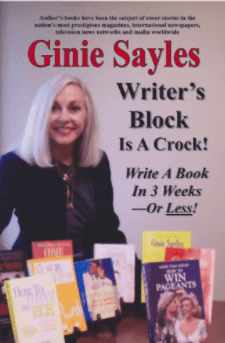
One of my favorite books for overcoming writer’s block

Fear is always the toughest one for me to manage. It isn’t fear of criticism, so much as it is fear of not being able to create a work that I’m proud of. I fear that I will write a mediocre text. And if there’s one thing I detest, it’s mediocrity.

Fortunately, I have great friends that encourage me to make my work better. They give specific examples of how it can be better. Then they trust me to make up my own mind, either to accept or reject their advice. I’ve done both, and I’ve been pleased with the outcome each time. They don’t take it personal if I choose a different strategy. But because they have great perspectives, I rarely discard their advice.

So fear is one that I’m still working on, to be honest with you. That’s what I’m experiencing right now. That’s why I made meals from scratch, two days in a row, during the time that I should have been writing. But recognizing the emotion is the first step. And I’m relying on my friends to help me through it. If you don’t have a trusted counsel to help you with things like this, I advise you build that group NOW. I promise you won’t regret it.

That’s it for today. I hope you all are well. I’ll talk to you tomorrow.

*This post contains affiliate links.

reading list · writing

Writers Wednesdays – The Power of a Brain Dump

Welcome to another edition of Writers Wednesdays! I think this topic will be especially helpful to the writers that have a ton of ideas but can’t quite make sense of them all (or, that struggle to organize their thoughts).

Here’s a little story: this past weekend, I had every intention of writing at least 50k words (I know, ambitious). But I figured I could do it because I’m a little crazy and I love big goals. And, I planned to use voice typing to help me get the ideas out when I tired of typing by hand. It all sounded so easy . . .

Then I had a few visitors (extended family) drop by on Saturday. And they stayed FAR longer than normal. When they left, I was too sleepy to write. It was worth it, since I had a good time with them. But it took away a chunk of my writing time.

Then Sunday came and I realized I had tons of clothes to wash and put away, dinner to prepare, overall home tidying to do, items to put in my shed, etc.,. My to-do list was overwhelming. It looked like I wouldn’t have any time to write.

But I got the idea to voice type as I folded clothes. That one decision allowed me to get 800 words out of my head and into print. It was a lot less than the 50k, but it sure beat 0 words. It wasn’t very well structured, but it was a brain dump that allowed me to get a few ideas out, and I can always mold my thoughts later. The important thing was to just WRITE: I’ll worry about the editing later.

***************

When you decide that you want to be a writer (part time or full time) you quickly realize that every other thing that you have to do magically becomes urgent and need attention during your designated writing time (that is, if you have actually scheduled a writing time). It’s almost inevitable (Murphy’s law and all that jazz).

If you find it difficult to reach your daily writing goals, I recommend that you pull up a Google Doc or Microsoft Word document, turn on the voice typing feature, and talk out your ideas while you do another task (like folding clothes, washing dishes, or cooking). That way, you can just “dump” the ideas instead of waiting for free time to type.

Clearing your mind via a brain dump can really help you become more efficient in other ways. Once I finished doing my voice typing, I could concentrate more on the tasks at hand. Doing a brain dump helped me feel more accomplished, and that motivated me to take care of my other tasks.

Do you ever do brain dumps when writing? I’d love to hear more about your process in the comments below!

writing

Writers Wednesdays – Choosing a Topic

Hi everyone! Last week, I mentioned that I had something special coming . . . And here it is!

I’m doing a writing challenge (so far, I’m the only participant!) for the next few months. Since one of my New Year goals is to publish 5 books in this year, I knew that I’d need to make writing a more permanent part of my routine. Going forward, each Wednesday will be Writers Wednesday, where I will discuss a different topic related to the book that I’m working on at that time.

This week, I’m discussing the importance of choosing a topic- or, rather, letting a topic choose YOU. It’s funny: whenever I decide to write a book, I am careful to allow inspiration to take me to the topic that I should develop. Whenever I try to overstep inspiration and “force” a book idea, I end up giving up before I can finish. I need the initial fire of inspiration to help me identify topics that will hold my interest from start to finish.

If you find it hard to finish a book that you’re writing, it may be helpful to examine whether the topic truly interests you and feels inspired, or if it’s a topic that you chose because it seemed logical (for instance, writing a book about cooking because you’re a chef). Sometimes, “logical” topics are uninspired and end up taking a lot longer to complete than topics that somehow “find you”: these subjects aren’t necessarily your current area of expertise, but you still feel compelled to write about them. When you rely on your emotions moreso than your reasoning mind, you’re probably operating from inspiration.

Now, don’t get me wrong: it’s possible to choose a book topic using logic and feel inspired while writing it. But if you find that you’re losing interest before you can complete your manuscript, you’re probably “forcing” your writing, which takes the joy out of the process. Learn to listen to inspiration so that you can enjoy your writing as you complete your book.

I selected my topic for my current book, and I will start writing today. I’m excited to see where this process leads me! I’ll give you all more details next week, but until then, take care.